Surge in unfair dismissal claims floods Fair Work and strains employers
The Fair Work Commission (FWC) has warned that a surge in groundless AI-generated claims is compromising the tribunal’s effectiveness and posing alarming consequences for employers.

The Fair Work Commission (FWC) has warned that a surge in groundless AI-generated claims is compromising the tribunal’s effectiveness and posing alarming consequences for employers. FWC President Adam Hatcher points to a 70% rise in workplace claims as the key challenge, noting that staff workload has “increased significantly”. As Figure 2 demonstrates, growth has spiked in recent years, illustrating the burden the FWC currently faces.
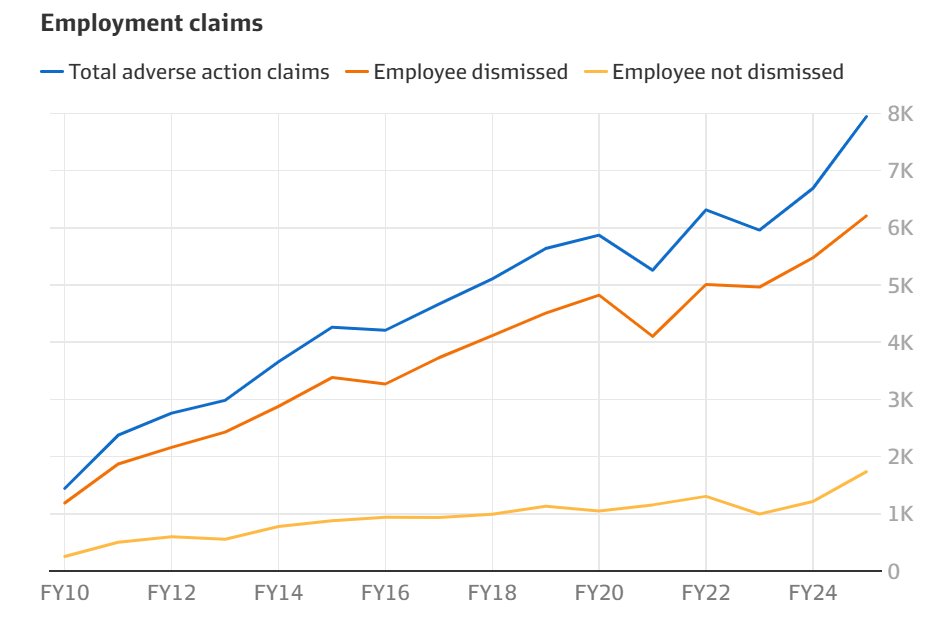
Beyond an increase in AI use, there is evidence that the deluge of claims may also be motivated by a new business model: unqualified agents are commercialising and automating unfair dismissal and general protection claims to harvest ‘go away’ money from employers. Furthermore, there is an increase in high profile cases in the media which may be raising awareness of employee entitlements. For employers, the effects are felt in the greater risks in employee dismissal. Firms may consequently be less likely to terminate employment and instead opt to keep unproductive employees on the payroll. This can harm productivity, reduce job mobility and burden workplace culture.
The problem is worsening, with the number of lodgements set to surpass a record high 55,000 this financial year, and the FWC failing to hit its key benchmark of resolving 90% of cases within 12 weeks, falling to 85% for the first time in years. While the FWC has sought out various options for reform, such as declaring AI use in applications and streamlining processing for simple disputes, there are calls for further legislative reform to enhance efficiency of the tribunal and reduce caseload. Any reforms may prove vital in protecting the integrity of the FWC, an organisation which fundamentally ensures the labour market operates in a stable and assured manner.
Like what you’re reading?
Contact us for more information, insights, or to share your thoughts regarding this article.