Rising trade wages challenge the payoff from a university degree
The economic value of a university degree is under renewed pressure as higher education costs rise while graduate wage growth slows.
.jpg)
The economic value of a university degree is under renewed pressure as higher education costs rise while graduate wage growth slows. Tuition fees have increased sharply over the past decade, leaving many students finishing study with HECS debts above $25,000. At the same time, starting salaries for graduates have stagnated or declined in real terms, weakening the traditional promise of a reliable earnings premium. Graduate employment outcomes have also softened. More than 30% of bachelor graduates now struggle to secure full-time work within six months, particularly in non-vocational disciplines such as humanities and communications. With the cost of degrees rising between 20% and 50% since 2021, delayed entry into stable employment has become a growing financial risk rather than a short transition period.
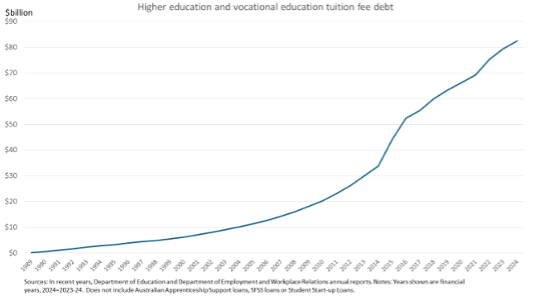
Figure 1 highlights a key structural force behind this shift. Student debt linked to higher and vocational education has risen steeply, accelerating after the late 2010s and approaching $90 billion. The sharp upward slope reflects both higher fees and longer repayment horizons, increasing the opportunity cost of study just as labour market returns become more uneven.
Against this backdrop, trades have delivered stronger and more predictable wage outcomes. Electricians, plumbers and builders are now earning median incomes comparable with, and in some cases exceeding, graduates in business, science and arts. Lower upfront costs and earlier workforce entry allow trade workers to earn and save during years when university students are still accumulating debt.
Postgraduate study further illustrates the divide. Masters degrees in data science, engineering and health continue to offer clear salary benefits, while lower demand fields often fail to deliver meaningful gains despite much higher fees. For school leavers, the implication is increasingly clear. University remains a strong investment in high demand areas, but trades and vocational pathways now offer a more reliable financial return for many Australians.
Like what you’re reading?
Contact us for more information, insights, or to share your thoughts regarding this article.