Older Australians transform the workforce as retirement ages climb
The workforce is undergoing a structural shift on a national scale, as more people work longer and retire later.

New analysis shows the expected retirement age in Australia in 2025 has risen to 67 for men and 65.3 for women. These increases reflect a decade of changes in pension eligibility settings and a broader cultural shift among older Australians who are more willing and able to stay in the workforce. The trend predates the surge in post-pandemic living costs, suggesting the transformation is not just a financial response but a deeper change in the nature of work.
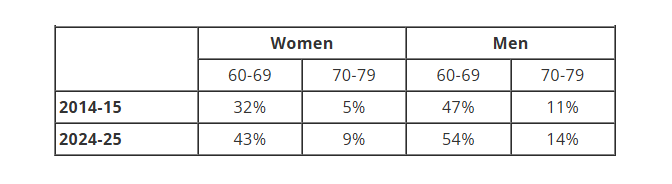
Figure 1 shows labour force participation among older Australians rising across the past decade. Women aged 60 to 69 have lifted participation from 32% in 2014-15 to 43% in 2024-25, while participation for women aged 70 to 79 has almost doubled. Men have followed a similar pattern, with participation increasing from 47% to 54% for those aged 60 to 69 and from 11% to 14% for those aged 70 to 79. The steady increases for both genders illustrate how older cohorts are becoming a larger and more stable part of the national labour supply.
Several forces are behind this shift. With the economy increasingly service-oriented, work has become less physically demanding, allowing pension-aged workers to continue working on a part-time or flexible basis. Many older workers are embracing semi-retirement by staying attached to the workforce even after leaving full-time employment. According to surveys, roughly a quarter of retirees go back to work in some form or another. Better health outcomes are extending working lives, while financial factors, such as pension eligibility and retirement savings, are becoming more powerful drivers.
These changes create a mixed outlook for employment outcomes. A larger older workforce eases labour shortages, supports knowledge transfer and stabilises the labour supply in the ageing economy. At the same time, it may obscure productivity challenges, widen generational differences in job mobility and require employers to redesign roles and workplaces in order to accommodate the increasing number of age-diverse teams. Australia’s long-term economic trajectory will depend on how well the labour market adapts to this profound demographic transition.
Like what you’re reading?
Contact us for more information, insights, or to share your thoughts regarding this article.