New data shows partial VET training delivers strong job and income gains
Australia’s skills system may be undervaluing partial VET participation, with new evidence showing that students who do not complete full qualifications can still record stronger employment, income and participation outcomes.

Australia’s skills system may be undervaluing partial VET participation, with new evidence showing that students who do not complete full qualifications can still record stronger employment, income and participation outcomes. Jobs and Skills Australia’s VET National Data Asset found partial completers achieved a 75% employment rate one year after training, up 10 percentage points, while median employee income increased by $7,000. The findings are important because non-completion is typically treated as system leakage, even though some students leave after gaining useful skills, moving into work or shifting into other pathways.
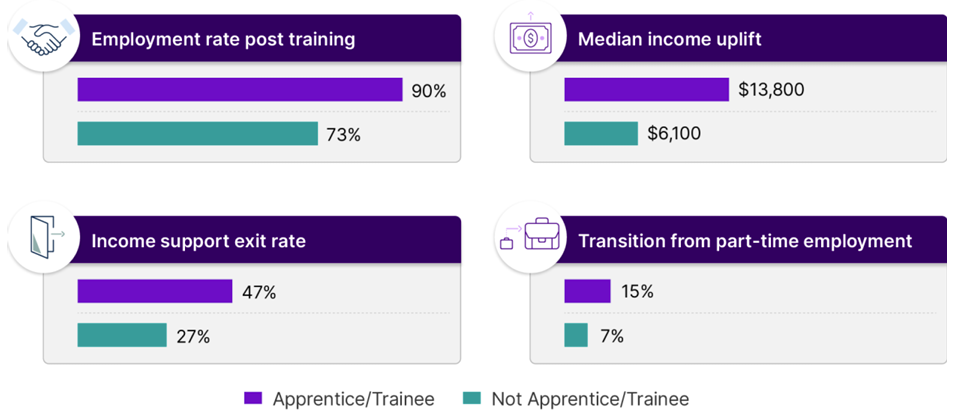
The strongest results appeared in apprenticeships and traineeships. As seen in Figure 1 above, partial completers in these pathways recorded a 90% employment rate and a $13,800 median income uplift, nearly double the national partial-completer uplift, while 47% of those previously on income support exited it after training. These outcomes likely reflect the job-embedded nature of apprenticeships, where even partial training can provide practical skills, workplace experience and stronger attachment to occupations already facing shortages. However, the National Centre for Vocational Education Research’s (NCVER) 2025 outcomes report reinforces that completing qualifications remains valuable, with 62.4% of qualification completers reporting improved employment status after training, while separate completion-rate data shows only 49% of qualifications commenced in 2020 were completed within four years.
This distinction matters for policy because VET program success is often judged heavily through completion rates. Although low completion should still raise concern, JSA’s findings suggest non-completion should not automatically be read as wasted funding or outright policy failure. This is particularly relevant in apprenticeships and traineeships, where postings have fallen well below pre-pandemic levels even as skill shortages persist. Where partial training improves employment, earnings and income-support outcomes, governments may need broader measures of program performance that capture skills gained, labour market attachment and later re-entry into training, rather than treating the final qualification as the only meaningful result.
Like what you’re reading?
Contact us for more information, insights, or to share your thoughts regarding this article.