Higher participation postpones but cannot remove Australia’s ageing squeeze
Treasury’s newly released 2026 Intergenerational Report sets out how Australia’s population, economy and Commonwealth budget could change over the next forty years, providing a more optimistic labour-market outlook than in 2023.

Treasury’s newly released 2026 Intergenerational Report sets out how Australia’s population, economy and Commonwealth budget could change over the next forty years, providing a more optimistic labour-market outlook than in 2023. As seen in Figure 1 below, participation is projected to peak at just under 68% in 2039–40 before easing to below 65% in 2065–66, as stronger workforce attachment among women and older Australians partly offsets population ageing. The new peak is 1.1 points higher and occurs later than forecast in the 2023 Intergenerational Report, with these newest estimates alone meaning that real GDP would be around 2.2% higher in 2062–63 than under its previous assumption.
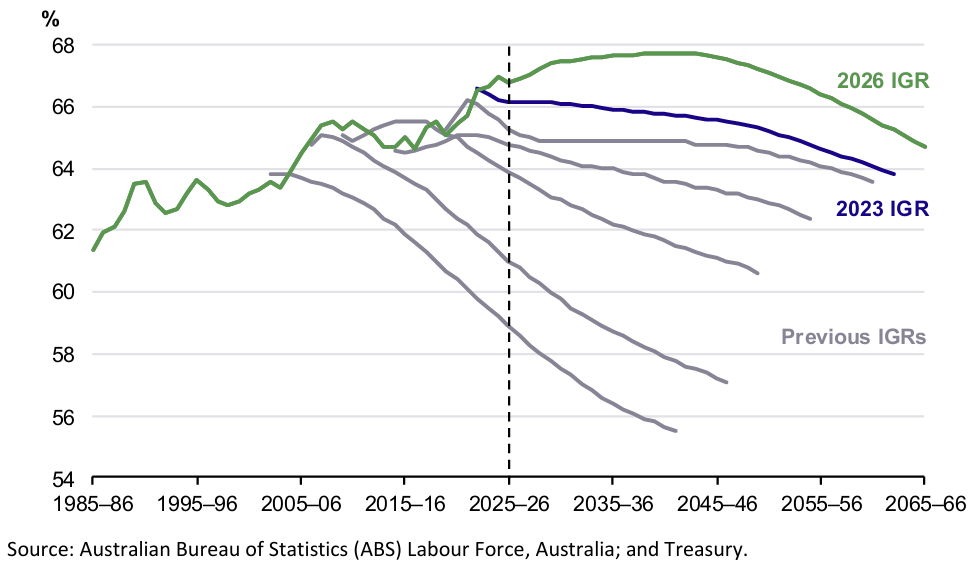
The upgrade reflects a modelling change as well as recent labour-market performance. Prior modelling tended to understate persistent participation gains within age groups, particularly among women and older Australians. Female participation rose more than twice as much as male participation between 2020-2025, with 15.8% of people aged 65 and over being employed in June 2025, up from 6.8% in 1978. However, Treasury projects average weekly hours per employee falling from 31.4 to 30.6 by 2065–66, meaning the opposing forces will likely offset the demographic drag without fully replacing the labour capacity lost through ageing.
The limits of that offset become clearest in the care economy, as the number of Australians aged 85 and over is projected to nearly triple to 1.9 million, while employment in healthcare and social assistance is expected to grow 22.9% by 2035, the fastest rate of any industry. The care services industry therefore acts on both labour supply and demand, as it enables parents and other family carers to enter the workforce, while also requiring large, often hands-on workforces. The report therefore pushes an implied expectation on employers and government to retain older workers and raise output per hour, as labour demand shifts further towards care as Australia’s ageing squeeze remains seemingly inevitable, just not quite as soon as previously thought.
Like what you’re reading?
Contact us for more information, insights, or to share your thoughts regarding this article.