Employment scams rise in prevalence as cost-of-living pressures expose vulnerabilities
Employment scams have spiked in the previous 12 months as perpetrators exploit those vulnerable to cost-of living pressures.

Employment scams have spiked in the previous 12 months as perpetrators exploit those vulnerable to cost-of living pressures. Scammers perpetrate such fraud by impersonating well-known companies and offering low-effort, high-paid jobs, before requesting payment to submit a job application and taking off with the victim’s money. The schemes are often conducted via online advertising or via direct communication channels like text messaging or email, with survey data indicating that 42% of Australians have encountered a job scam, demonstrating their prevalence and potential for financial harm.
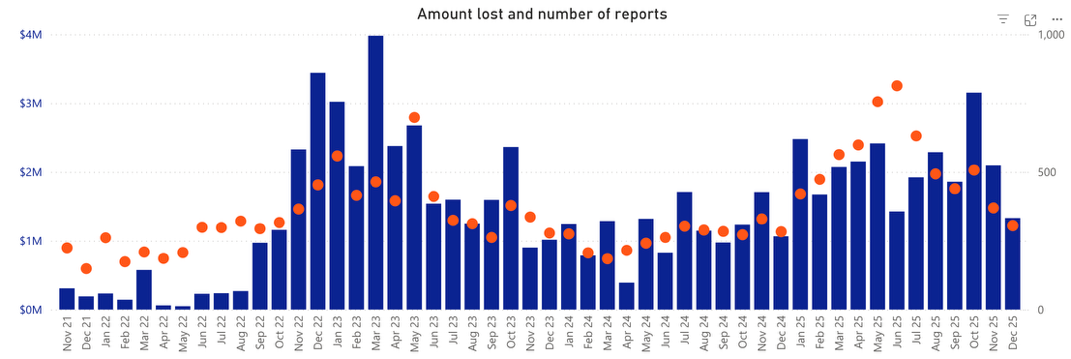
Statistically, the rise of these scams over the past year is cause for concern, particularly given the current macroeconomic climate and the impact on younger demographics. Job scams have resulted in $24.8 million total losses in 2025, with Figure 2 demonstrating a weak but noteworthy positive correlation with inflation post Aug-22. This implies that perhaps individuals are more prone to scams in financially precarious circumstances, or that scammers are simply more active during these periods. There was also a sharp rise in how many young Australians fell victim to job scams, with the number of people aged 24 or younger affected more than doubling since 2024, from 361 to 837, and losses totalling over $2.2 million.
Despite the growth, only 1.1% of all scam losses are of the employment kind, with the latest ACCC data indicating that Australians lost a total of $2.18 billion to scams in 2025. Nevertheless, these schemes can distort labour market signals, impair labour mobility and reduce labour market participation, illustrating their impact on the broader economy.
Like what you’re reading?
Contact us for more information, insights, or to share your thoughts regarding this article.