Data centre investment surges in Australia, but jobs payoff remains limited
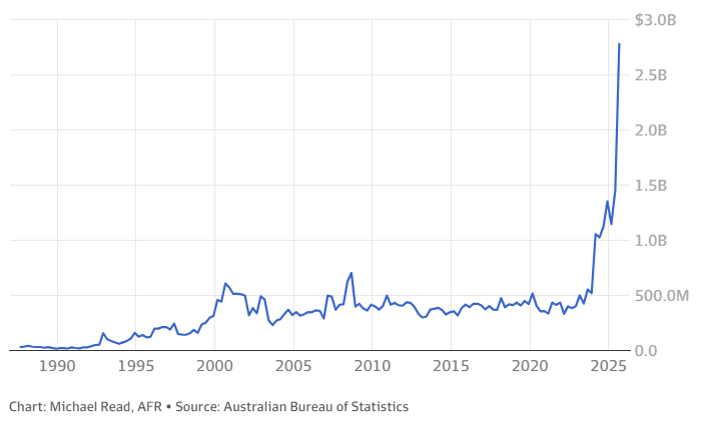
Australia’s rapid push into data centre investment has intensified as capital spending in the sector doubled to $2.8 billion in the September 2025 quarter
Australia’s rapid push into data centre investment has intensified as capital spending in the sector doubled to $2.8 billion in the September 2025 quarter after reaching $1.4 billion in March. The surge is contributing to the strongest rise in business investment since early 2021 and is lifting hopes thatAustralia may finally see improvements in productivity and economic growth after several sluggish years. Economists at CBA suggest the scale and speed of these plans indicate a broader recovery in economic activity is gathering momentum.
Figure 1 shows quarterly investment in IT sector machinery and equipment increasing sharply after decades of relatively steady levels.Spending remained below $500 million for most of the 1990s and 2000s before beginning to accelerate in the early 2020s. The steep rise to almost $3 billion in the latest figures reflects the expanding demand for AI computing capacity, cloud services and high-density data storage that require specialised and energy intensive infrastructure.
Despite the rapid growth, the future remains uncertain.Industry leaders argue that Australia has not decided what role it wants to play in the global data centre boom. They highlight slow approval processes, limited government support and a shortage of energy transmission infrastructure. Forecasts show data centre electricity demand could rise almost five times by 2036, increasing pressure on power prices and emissions reduction goals. These constraints may also limit the speed and scale of new investment. Data centres create thousands of construction jobs over multiyear building phases, but operational staffing needs are small once facilities are finished. A recently approved $3.1billion New South Wales project will support about 220 construction roles and only 265 ongoing jobs. Victoria is also pursuing expansion, with thePremier signalling a strong commitment to attract new digital infrastructure. Whether this investmentwave delivers lasting employment and economic benefits will depend on howAustralia resolves its energy and regulatory challenges and how competitive the country becomes in the global AI infrastructure market.
Like what you’re reading?
Contact us for more information, insights, or to share your thoughts regarding this article.