Changing skill needs reach beyond the IT slowdown
Australia’s softer IT recruitment market highlights a broader workforce challenge: having more applicants does not guarantee businesses can find the capabilities they need.

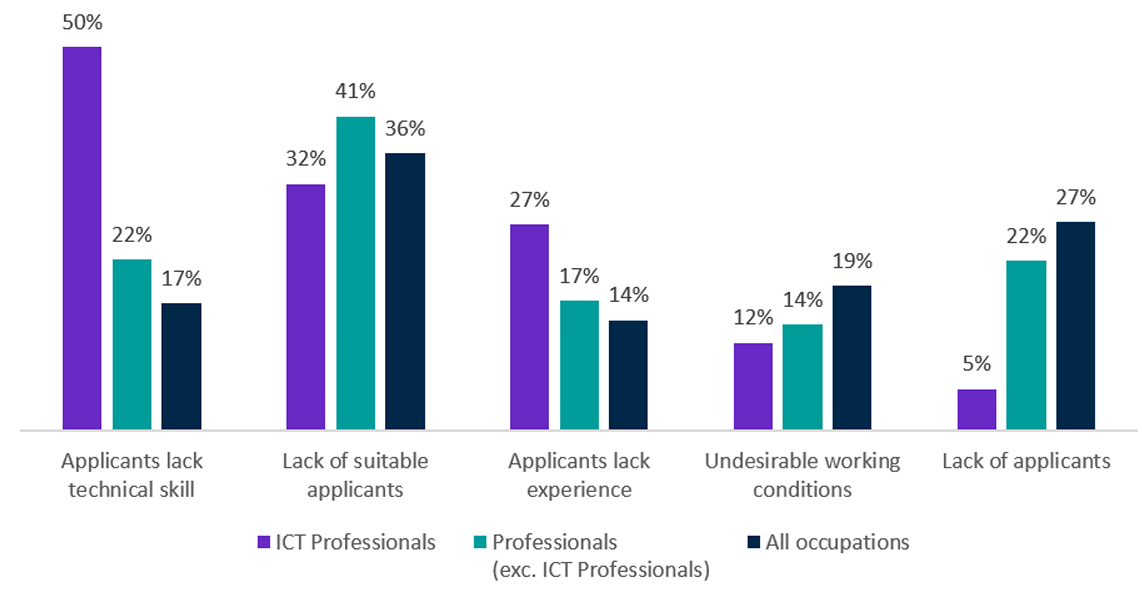
Australia’s softer IT recruitment market highlights a broader workforce challenge: having more applicants does not guarantee businesses can find the capabilities they need. As technology, regulation and business priorities evolve, matching skills to changing work remains important for employers and employees across industries. Only 32% of IT employers were recruiting in 2025–26, compared with 49% across industries, with weak demand for services becoming their leading concern. However, pooled survey results show employers recruiting ICT professionals were comparatively more likely to report missing technical skills and less likely to report insufficient applicants. Easier recruitment can therefore coexist with difficulties finding particular capabilities. As Figure 2 shows, recruitment difficulties among ICT professionals are more commonly linked to missing technical skills than insufficient applicants, highlighting why larger candidate pools do not necessarily resolve skills mismatches.
The implications extend beyond IT. Workforce research covering finance, technology and business identifies changing capability requirements alongside diverging occupational demand. These developments reflect several overlapping forces, including economic conditions, regulation and technological adoption. Existing roles are also acquiring additional requirements. Sustainability reporting is creating capability needs in emissions accounting, climate risks and scenario analysis for accountants, advisers and company staff. In healthcare, increasing use of digital systems is prompting training to help nurses and midwives deliver contemporary care. Skills development increasingly involves extending established expertise.
While AI is reshaping tasks, Australian research has not established broad AI-driven employment disruption, making it premature to attribute softer hiring primarily to automation. For employers, this strengthens the case for reviewing how tasks are changing and directing training towards specific capability gaps. For workers, it provides an opportunity to build on existing experience as role requirements evolve. A quieter hiring market can offer businesses time to develop their workforce for future needs. Reviewing job descriptions, consulting staff about changing tasks and recognising transferable expertise can help businesses identify where existing employees could develop the capabilities they need.
Like what you’re reading?
Contact us for more information, insights, or to share your thoughts regarding this article.