Australia moves to turn AI exposure into better jobs, not just automation
Australia’s artificial intelligence debate is shifting from a narrow technology issue into a broader discussion about jobs, industrial capability and economic sovereignty.

Australia’s artificial intelligence debate is shifting from a narrow technology issue into a broader discussion about jobs, industrial capability and economic sovereignty. Unions are pushing for government-coordinated development of local AI models, arguing sovereign AI is needed to protect workers and give the technology a stronger social licence. The concern is not simply that AI will replace jobs, but that Australia could become a passive consumer of systems designed, priced and governed offshore.
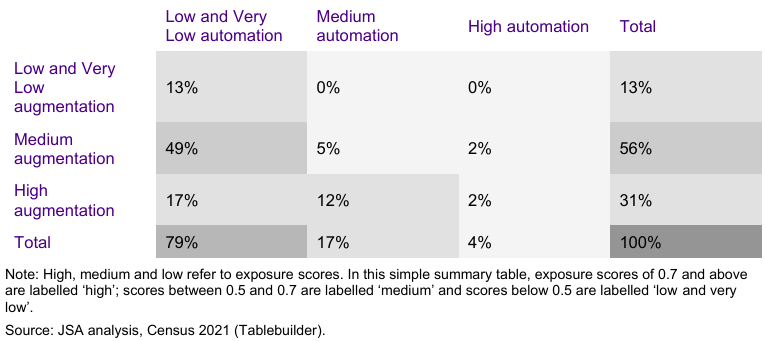
Jobs and Skills Australia’s Gen AI Capacity Study suggests the labour market impact of AI is more likely to come through job redesign than immediate mass replacement. As shown in Figure 1 below, most Australian workers face low or very low automation exposure, yet much higher exposure to AI is changing how they perform their jobs. These projections reframe the sovereign AI debate, because if AI is mostly going to reshape tasks, then possessing greater ownership of the technology may help determine whether the gains flow into productivity and better jobs or into cost-cutting and labour displacement.
The Federal Government’s National AI Plan reflects this broader industrial policy challenge, aiming to build smart infrastructure, support domestic AI capability, attract investment, train workers and establish stronger safety oversight. Recent developments in this space include a memorandum of understanding between NEXTDC and OpenAI for AI infrastructure projects, while Anthropic has agreed to share economic data with the Australian Government to help track AI adoption and its impact on workers and jobs. The labour market opportunity is that greater sovereign AI capabilities could create work across the AI supply chain. However, without a domestic skills pipeline and clear governance, Australia risks hosting AI infrastructure without capturing enough of the higher value work attached to it. Sovereign AI is therefore becoming a test of whether Australia can shape the next productivity wave, rather than simply absorb it.
Like what you’re reading?
Contact us for more information, insights, or to share your thoughts regarding this article.