AI costs complicate labour market disruption narrative
The labour market impact of artificial intelligence may be slower and more uneven than early automation fears suggested, as businesses confront the rising and unpredictable cost of deploying the advanced tech at scale.

The labour market impact of artificial intelligence may be slower and more uneven than early automation fears suggested, as businesses confront the rising and unpredictable cost of deploying the advanced tech at scale. While AI remains a major long-term productivity opportunity, the economics of implementation are becoming more complicated as firms move beyond simple chatbot use toward reasoning-heavy tasks, workflow integration and enterprise-wide adoption. CBA chief executive Matt Comyn recently warned that corporate AI costs do not scale in a simple linear fashion, with businesses paying according to “tokens” (the amount of text processed) rather than flat consumer-style subscriptions.
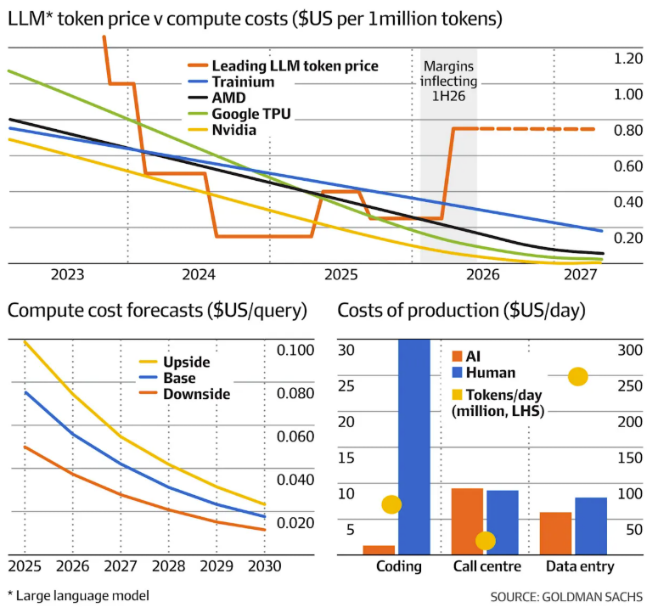
As demonstrated by Figure 1 above, the cost of AI implementation varies significantly by task, with coding appearing far cheaper than human labour while call centre and data-entry applications show narrower price advantages. This matters for the labour market because AI adoption is unlikely to affect all jobs equally. Where the cost gap is large and outputs can be easily verified, firms may have stronger incentives to automate or slow hiring. However, where AI requires heavy supervision, domain expertise, infrastructure spending or repeated human correction, the productivity payoff may be smaller and the case for immediate labour replacement less clear.
This shifts the AI employment debate away from a simple narrative of rapid job destruction. Goldman Sachs has estimated that around 300 million jobs globally are exposed to AI automation, but it also argues that broad labour market disruption depends heavily on the speed and scale of adoption. In practice, high implementation costs may mean AI is adopted first by large, well-capitalised firms, while smaller businesses face slower uptake. Australia’s emerging AI investment cycle also reinforces this point, with Westpac estimating a $155 billion domestic data centre investment pipeline. AI may still reshape employment, but its impact is likely to be patchy, capital-intensive and concentrated among firms able to convert costly technology into measurable productivity gains.
Like what you’re reading?
Contact us for more information, insights, or to share your thoughts regarding this article.